
Minivan Campers Conversion Design Guide
- Dennis Alex

- Jul 30, 2022
- 7 min read
Introduction
The designing of many minivan camper custom builds start with setting up a floor plan layout without much thought to right-sizing those space allocations. Perhaps this look from a different angle, will be helpful to you, in your design phase.
The Journey:
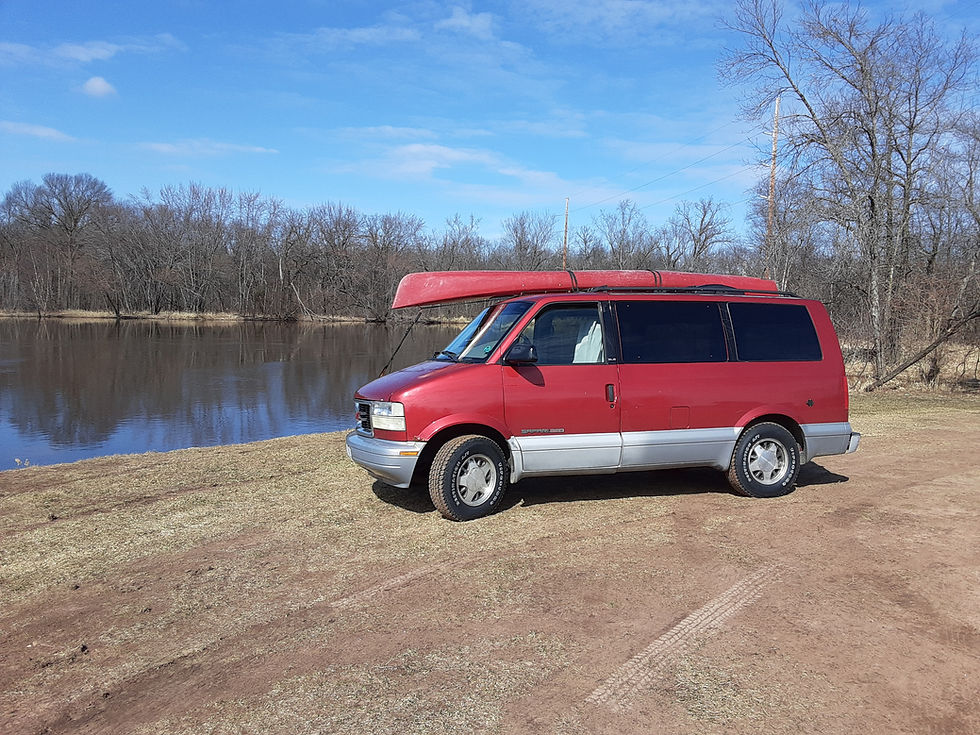
Often what people find when they start using a new minivan camper conversion, is an immediate creation of a mental list of – changes that they want to make to the build! That’s often because the way they imagined living in that space turns out to be different in real day to day living.
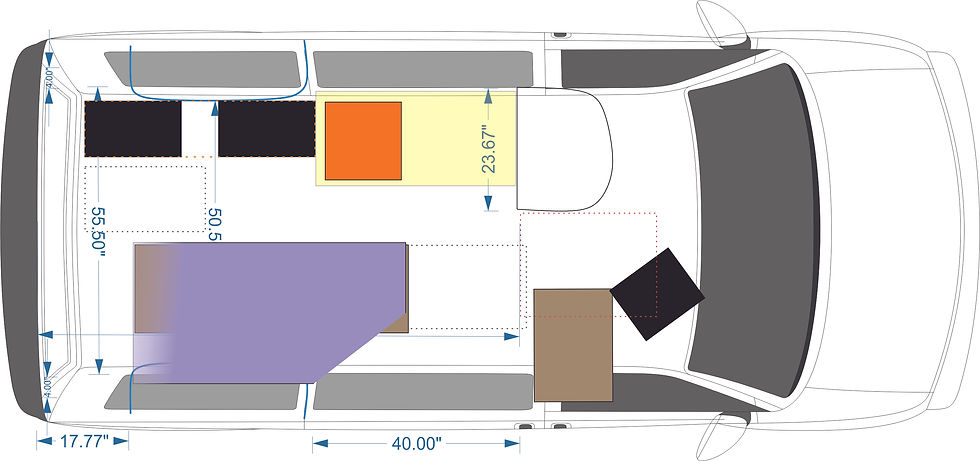
Most people start out with a floor plan or a bunch of ideas they’d seen online. While that’s good, what they are actually looking at is a space designed for someone else’s use. Not their own. They don’t give much thought to re-sizing that layout to fit their particular needs.
The more ways a person knows to look at solving things, the better their solution will become.
So, while looking at a floor plan is good, it’s even better to look at your design ideas from more than just one angle. Here, we’ll explore a method of sizing your ideas to fit your style of minivan camper.
Defining Your Minivan Camper Style
The main element in right-sizing your overall design is defining your minivan camping main purpose. To do that isn’t complicated. In fact, as you’ll see, it’s as easy as answering just three basic questions. While it’s likely your experiences are going to involve many uses, what were after here is determining one, that you’ll be involved in the most. The three questions are:
1) Whether or not you have a Home Base.
2) The main Environment you will spend time in
3) The primary use Mode for your minivan camper
It’s not often that forums, videos or blogs address whether a minivan conversion user has a home base. The discussion usually surrounds camping places, equipment, or performing tasks. But whether or not a camper has a home base is probably the single biggest factor that involves right-sizing your conversion design and storage space allocation for each of those design elements.
People that have a home base, whether your doing one overnight trip, or many nights away, don’t need to concern themselves with things that aren't needed or used on a day to day basis.
People that don’t have a home base, are essentially packing their entire life into that minivan. Things that they need only occasionally need to be included ~
One example is paper documentations. Even if we only use them once a year for things like tax preparation, or certificates we might need to produce to prove our identity, medical receipts kept in case of a future billing dispute, legal items like wills or power of attorney that require our notarized signature. Even in this digital age, we still keep at least a small file system for paper based records.
Other items can include things like tool sets to do periodic maintenance , clothing or outdoor gear that will cover all four seasons of weather, family heirloom items you don’t want to give away, specialized chemicals that we use only every so often. Personal hobby items that a part-time vehicle dweller may not bother with. You get the idea – someone going on even an extended six or eight month travel tour, isn’t going to need to pack their entire life into that vehicle.
And it makes a big difference in organizing storage space and a layout plan.
Categorizing Space: The Starting Point For Allocating It
We’re going to categorize our space in these five areas –
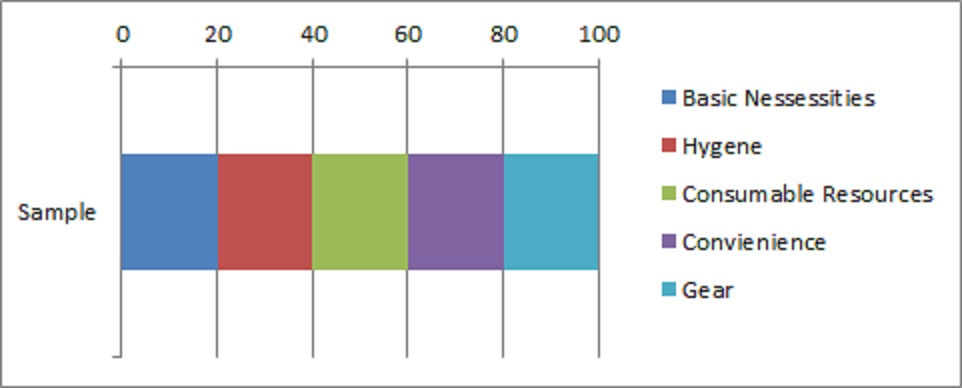
Then, answering the three questions will determine a starting point for how much of your total space, you might realistically allocate to each of them. This is what will give you a valuable perspective on right-sizing your van conversion space.
Basic Necessities – think of these as daily use, non-consumable items. Another way to define them are the items listed in a hikers 10 Essentials list. Cloths, sleep system, light ... etc
Hygienic items – Managing cleanliness and waste
Consumable Resources – Food, water, fuel, personal care things
Convenience Items – Electrical power, refrigeration, heat, comfort features and aesthetic things
Gear – this more commonly outdoor equipment for camping or sports. But it can also be items needed for being employed while your mobile. Work gear can include trade tools, connectivity devices, employer owned computers, paper files or literature, musical intruments, artistic supplies, audio-visual equipment, work specific clothing – like uniforms. Things commonly needed for traveling occupations like construction, nursing, performing artists or digital content creators.
The Use ENVIRONMENT
The Environment question splits the main use into three choices, Conventional Camping, Urban, or Remote / Dispersed areas.
Conventional Camping is using the common public or private sites, that have nearby utilities, and facilities. This is a paid for stay, with access to water. There are toilet facilities. They often have a shower available. Perks can include access to electricity, wifi, ice and firewood. Reasonably close access to a town or city for resupplying is more common than not. They can get by on moderate storage set aside for consumable goods, which gives them a good amount of space for gear. Most conventional campers have less of a concern for bad weather events, since they can often plan ahead or around them.
Urban campers have easy access to supplies, and public restrooms. They have means to a shower and publicly accessible wifi. They don’t need to have much space set aside for consumables, or gear – so they often have conversions that have a good amount space to accommodate for comfort features, or aesthetic items. This type of use might serve two adult travelers, since they use the conversion mostly as a sleeping area, and rely heavily on easy access to their common needs.
Remote / Dispersed camping is the most space demanding in planning a conversion. It differs from conventional camping in a greater need to be self sufficient, for longer periods of time. They require on board means for Hygienic needs, a large amount of space for consumables, and lean heavily toward functional builds with the least space for comfort or aesthetic features. Remote campers are likely invested in creating builds with multi-use interior design elements. They have a greater need to be able to accommodate living in the interior over extended time during bad weather events, and the risk of needing to use safety equipment is highest with this use environment. They are more inclined to see safety gear as a basic need, rather than a gear item. They might also see on board power, refrigeration and heat as a need, rather than a convenience.
MODES Of Use
Looking at the Modes of minivan camper use, we’ll divide that into three different categories. These modes also have a common correlating function associated with them. These categories are Travel, Recreation, and Dwelling.
If the most used mode is Travel, the common function leans most heavily toward comfort and convenience. Travelers will be spending the majority of their time in or near urban centers, having less of a need for self sufficiency, onboard gear, and consumables.
Recreation based conversion designs commonly have the function of gear hauler, being their priority for the conversion design. With only moderate space for consumables, they depend on being able to resupply within a few days time. And less space for convenience items means they are living closer to backpackers than elaborate car campers. There’s a huge variety of Recreation based gear, so this group comes up with inventive ways to store and organize it all. From hikers to bikers to climbers to kayakers to surfers to the many other outdoor recreations, there’s a good amount of gear that goes with them all, that’s in addition to the camping equipment.
A Dweller is someone who will be living out of their rig longer than a long vacation, or any extended trip that is planned, and has some kind of an end date. If you’ll be living out of your minivan for a long while, without an end date in mind, that will make your main function of your build, your sole support system. Whether you see dwelling out of the minivan as a temporary, or permanent goal, it focuses most on the three E’s: being Essentials Effectively and Efficiently. That means the effort you put into planning and designing your build is going to have a direct impact on your long term quality of life.
Answering 3 Questions: Defining Your Minivan Conversion Lifestyle
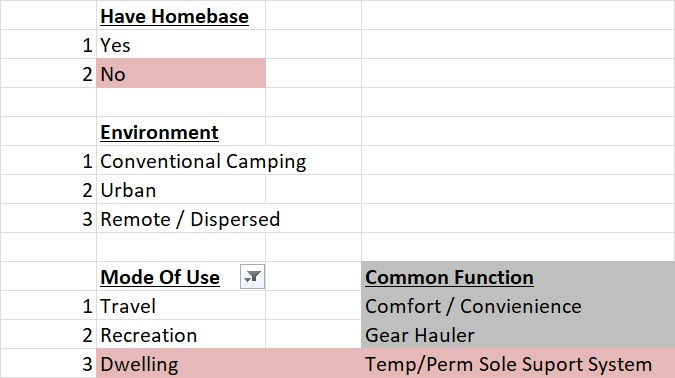
With that background into the three questions, lets go ahead and define your minivan conversion lifestyle. Of these three questions, choose only one answer, and write down what number your choice is. Use a dash between your choices, in this format: #-#-#. If you chose the first answer for each of the three categories, it would look like 1-1-1.
Have A Home Base?
Note: If you answer No to Homebase, your only choice for Mode, is #3.
The Resolution: A Starting Point For Allocating Space For Your Design
There are going to be 12 combinations possible, yours is one of these:
ID Homebase Environment Mode Function
1-1-1 Homebase Yes Conventional Travel Comfort
1-1-2 Homebase Yes Conventional Recreation Gear Oriented
1-1-3 Homebase Yes Conventional Dwelling Temporary Sole Support System
1-2-1 Homebase Yes Urban Travel Comfort
1-2-2 Homebase Yes Urban Recreation Gear Oriented
1-2-3 Homebase Yes Urban Dwelling Temporary Sole Support System
1-3-1 Homebase Yes Remote Travel Comfort
1-3-2 Homebase Yes Remote Recreation Gear Oriented
1-3-3 Homebase Yes Remote Dwelling Temporary Sole Support System
2-1-3 Homebase No Urban Dwelling Permanent Sole Support System
2-2-3 Homebase No Conventional Dwelling Permanent Sole Support System
2-3-3 Homebase No Remote Dwelling Permanent Sole Support System
I’ve created an arbitrary percent of space allocation for each category. The big take-away is looking at the entire chart, and seeing that the main element in right-sizing your overall design is defining your minivan camping main purpose. Doing that prioritizes or minimizes the various space categories. Having this high level perspective is a help to right-sizing your design.
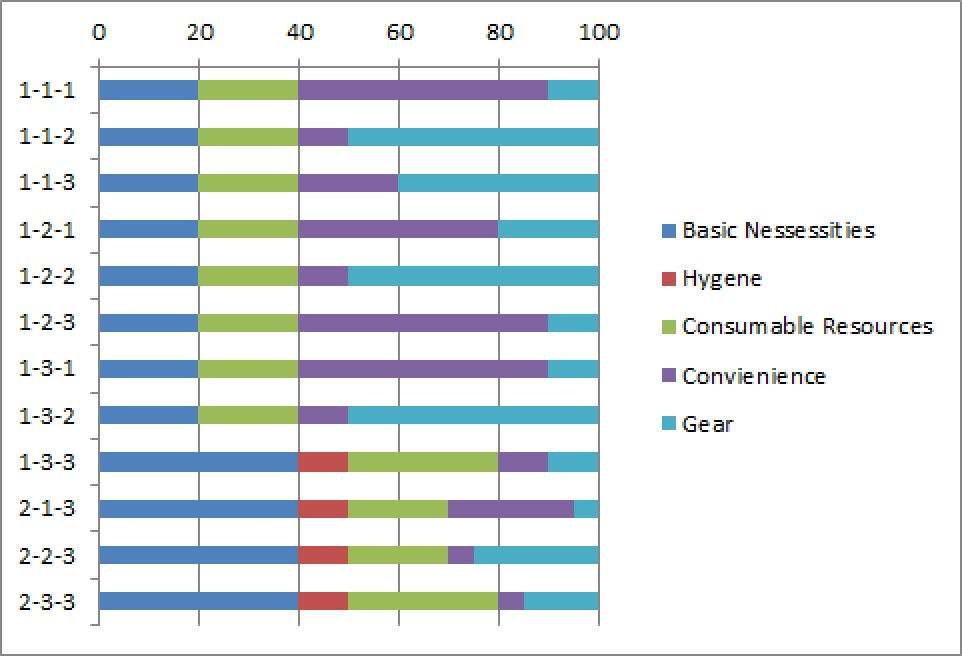
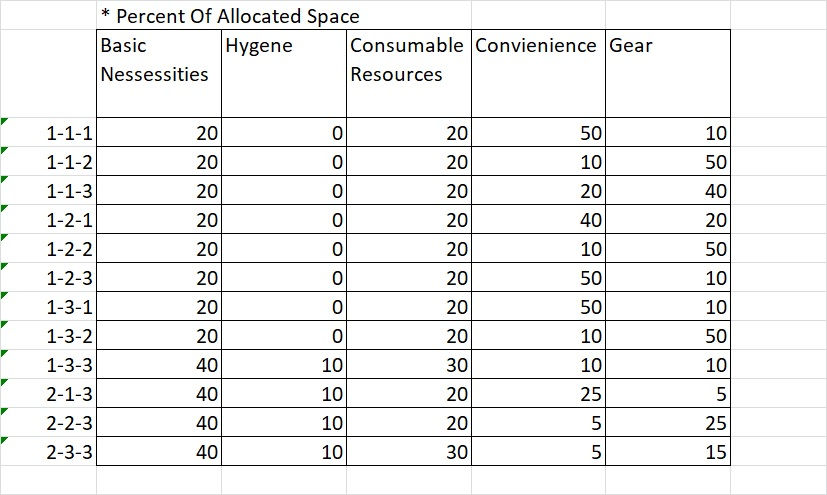
The second benefit is giving you a starting point in allocating the space in your own design. You can certainly change this to your hearts content, but having a place to start, is better than not having a place to start.
In example, if your three questions resulted in 1-1-1, Basic Necessities would start off with allocating 20% of your total space to that. Hygene 0%, Consumables 20%, Convenience 50%, Gear 10%. You can change it as you go. The single most important thing is that now, for everything you put into your floor plan, you'll have a mental picture of a category it fits into, and your own sense of priority for each of the five categories. The mental pictures, and your priority, will help you right-size your space as you go. Really, this is just a simple way to give your thoughts and plans direction toward your goals.
If you like: this blog has a correlating video, on my YouTube Channel:
https://www.youtube.com/channel/UC_OsMt5s4bCWiBTa1MRLkpA
I hope you’ve found this way to evaluate design ideas helpful to you.
Happy Mini-Vanning !
Added Notes:
-One of the biggest complains of vanlifers is needing to move an item, in order to get to something else. Good planning can greatly minimize that !
-For Dwellers, a place to comfortably sit upright inside, while you wait out bad weather, is golden. Sitting right means feet on the floor, nice seat cushioning, a slightly angled backrest with some lumbar support.

Comments